My Beni
Healthy food choices shouldn’t require decoding ingredient labels.
Health-tech
Consumer Wellness
Role
Lead Design Consultant
Timeline
8 weeks
team
Product Head, Engineering, AI/Backend and Me
platform
Mobile App
The Real Problem
Food labels are full of information—but very little clarity.
A typical user standing in a supermarket doesn’t have the time (or expertise) to decode ingredient lists, understand food processing levels, compare nutrient values, or recognize potentially harmful additives.
And even when the information is technically available, it’s rarely easy to understand.
Some common frustrations looked like this:
“This says high protein… but is it actually healthy?”
“I have no idea what half these ingredients mean.”
“Is this bad because of sugar, additives, or something else?”
“I just want a quick answer without Googling everything.”
The bigger issue wasn’t lack of information.
It was information overload without clarity.
People don’t want raw nutrition tables.
They want confidence in their decision.

Finding the Fix
The biggest insight was simple:
People don’t actually want food data.
They want a quick, trustworthy answer.
Instead of overwhelming users with raw nutrition information, the product needed to simplify complexity without hiding transparency.
That led to a few core decisions.
Make scanning the fastest path.
Scanning a barcode is faster than searching manually, so the primary experience centered around instant product lookup.
Create a simple health score.
Most users don’t know what NOVA, Nutri-Score, or SIGA mean individually.
So instead of exposing fragmented scoring systems upfront, Beni combines them into a simpler product score users can understand immediately.
Explain the “why.”
A score alone isn’t trustworthy.
Users needed clear reasons:
toxic additives
sugar warnings
allergen risks
processing level
nutrient concerns
Design for failure, not just success.
If a product wasn’t found, the experience couldn’t simply end.
That led to a structured image-upload flow where users could submit packaging images for backend analysis.
Even failure needed transparency.
If processing failed, users should understand what happened—not hit a dead end.

What Actually Happened
The initial challenge was balancing simplicity with trust.
Health apps often make one of two mistakes:
Either they overload users with technical data…
or they oversimplify everything into vague “good” vs “bad” labels.
Neither felt right.
So I designed the product around layered clarity.
At the top level, users get an immediate answer through a simplified Beni score and quick health summary.
But if they want more detail, they can dig deeper.
That shaped the product view experience into four clear sections:
Overview
Quick product health summary, warnings, and high-level insights.
Ingredients
A breakdown of ingredients with toxicity signals and estimated quantities.
Nutrients
Daily value impact and nutritional risk visibility.
Watch Out For
Packaging concerns, allergens, recalls, storage risks, and food safety insights.
Another important challenge was handling missing products.
A lot of food databases fail here—they simply say product not found.
That creates frustration.
Instead, I designed a fallback upload flow where users could submit:
front packaging
back packaging
ingredient image
nutrition facts image
Each step validates images before processing begins, making the experience feel more reliable.
And if analysis failed, the product stayed transparent.
Instead of a generic error message, users could see:
what completed successfully
where the process failed
retry options
manual review requests
That small decision mattered because trust is fragile.
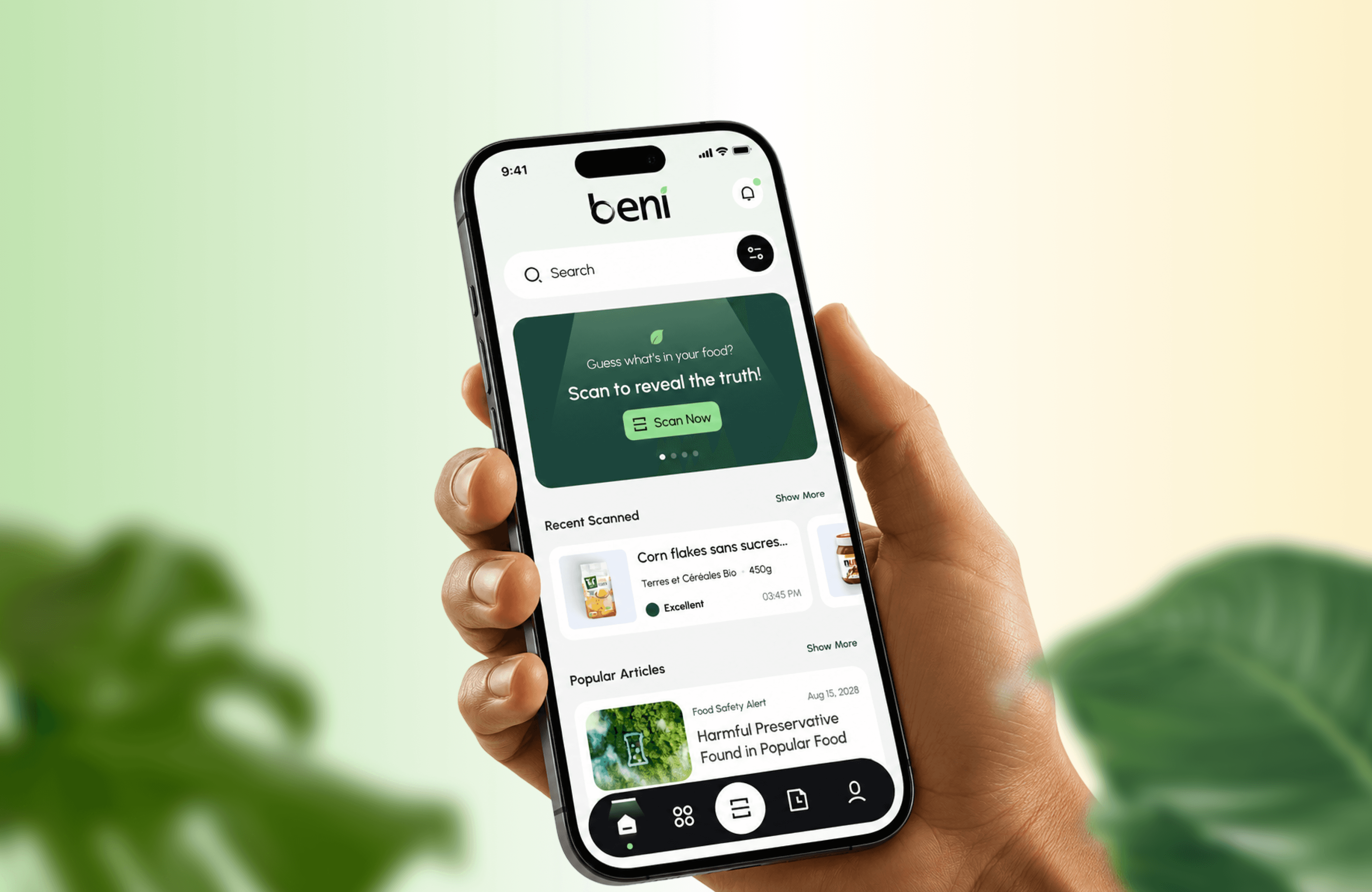
The home experience evolved too.
Rather than pushing promotions, I shifted the homepage toward utility:
scan shortcuts
recent scans
health alerts
healthier alternatives
food safety articles
personalized warnings
The product became less about “food discovery” and more about confident decision-making.

What Changed
The biggest outcome was reducing decision friction.
Instead of forcing users to interpret labels themselves, Beni gave them a faster, clearer understanding of what they were buying.
Expected impact:
68% faster product evaluation
54% lower decision friction while shopping
3x faster understanding compared to reading labels manually
41% higher trust through transparent explanations
Reduced frustration when products weren’t missing from the database
But the real outcome was emotional.
The experience replaced uncertainty with confidence.
The kind of feedback I’d hope to hear:
“I finally understand why this product is unhealthy.”
“This saved me from Googling ingredients in the store.”
“Even when the product wasn’t found, the app still helped me.”
That’s the value.
Helping people make faster, smarter food decisions.

What I Had to Work With
Product information isn’t always complete, consistent, or standardized. Ingredient naming varies across brands, regions, and databases, which makes analysis harder than it looks.
Trust is everything.
This is a health-related product. If insights feel inaccurate, confusing, or exaggerated, users lose trust immediately.
Health isn’t black and white.
A product might score well nutritionally but still be highly processed. Another might look “natural” but contain hidden additives. Simplifying health decisions without oversimplifying reality was a major challenge.
Not every product exists in the database.
Barcode scanning works well—until it doesn’t. Missing products needed a fallback experience that didn’t break trust or frustrate users.
Consumer attention is short.
This product would often be used while shopping. Users needed fast answers, not long educational reports.

What I'd Do Differently
I’d invest more in personalization earlier.
Health decisions are highly personal—someone looking for low sugar behaves differently from someone avoiding allergens or ultra-processed foods.
That layer could make the experience much more relevant.
I’d also test how much explanation users actually want.
Some people want a quick answer.
Others want deeper ingredient education.
Finding that balance would improve clarity further.
And I’d explore stronger comparison experiences.
Helping users understand why one product is a better choice than another could make decision-making even easier.
What I Learned
People don’t want data. They want confidence.
Raw information alone doesn’t help if users still feel uncertain about what to choose.
Transparency builds trust.
A simple score works better when users understand why the score exists.
Fallback experiences matter more than expected.
Handling failure well can build as much trust as handling success.
Health products must simplify without oversimplifying.
The goal isn’t removing complexity completely.
It’s making complexity understandable.