Infraon Workspace AI
IT teams lose time not because they lack tools, but because their work is scattered across too many of them.
Enterprise ITSM
AI
Role
Product Designer
Timeline
16 Weeks
team
Product Manager, Engineers, AI Team, QA, Customer Success and me
platform
Web
The Real Problem
At first, this looked like a ticket management problem.
But it really wasn’t.
The issue was everything happening around the ticket.
A typical service workflow involved multiple people—agents, engineers, approvers, managers—but the work was scattered across tools.
The ticket held one part of the story. Slack had another. Approvals lived elsewhere. Important updates sat in emails or direct messages.
That meant teams constantly rebuilt context just to move work forward.
Some recurring frustrations looked like this:
“I know this update exists somewhere.”
“I spend more time following up than resolving issues.”
“I’m not sure who owns this right now.”
Infraon already had strong workflows.
The missing piece was a shared workspace where communication and execution could happen together.
Finding the Fix
I mapped how teams actually handled operational work—not just ticket workflows, but the messy coordination around them.
A few patterns became obvious.
Communication and execution were disconnected.
Teams talked about work in one place and managed it somewhere else.
Ownership wasn’t clear.
Simple questions like “Who’s handling this?” became hard to answer.
Critical updates got buried.
Alerts, approvals, conversations, and ticket changes all competed for attention.
AI needed context.
Without centralized operational data, AI would just become another disconnected feature.
That shifted the direction.
Instead of improving ticket workflows, the goal became creating a shared workspace where teams could communicate, coordinate, and act in one place.
What Actually Happened
My first concepts looked more like dashboards.
Widgets. Metrics. Operational summaries.
They looked polished—but they didn’t solve the actual problem.
Dashboards help teams observe work. They don’t help teams collaborate through it.
That changed the direction completely.
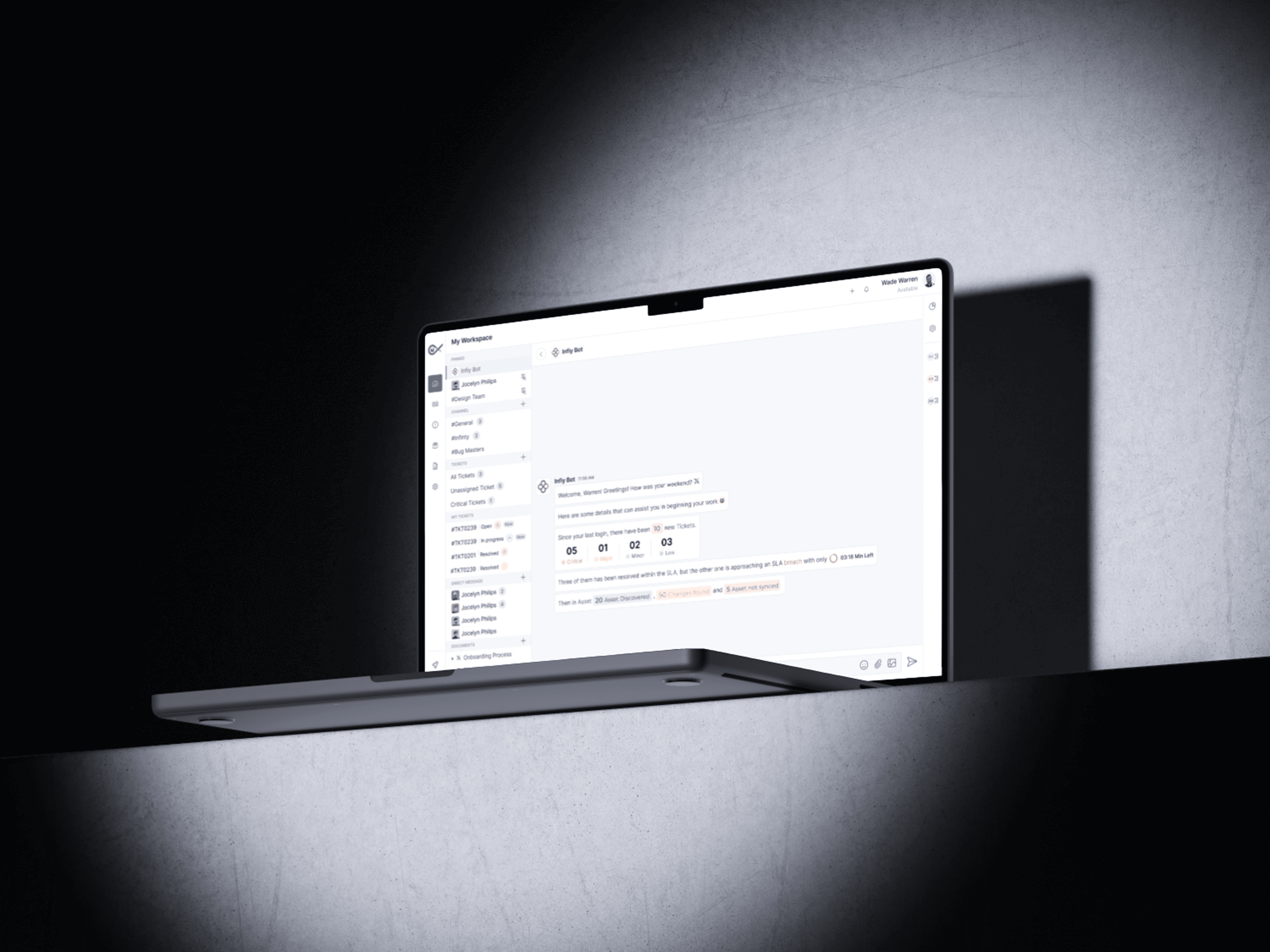
The workspace became less of a reporting interface and more of a shared working environment.
Channels and direct conversations were placed alongside ticket workflows so communication stayed connected to the work.
AI changed too.
Initially, I treated it like a separate assistant. That felt disconnected.
The better approach was embedding AI into moments where people naturally needed help:
summarizing ticket activity
surfacing SLA risks
highlighting unresolved priorities
helping teams catch up quickly
The biggest challenge was avoiding overload.
Early versions surfaced too much at once. Alerts, activity, AI suggestions, updates—everything felt urgent.
So I simplified the experience around one question:
What needs attention right now?
That brought much more clarity to the product.
What Changed
The biggest improvement wasn’t adding new features.
It was reducing friction.
Instead of jumping between tools, teams could coordinate from one shared workspace.
Expected impact:
35% less context switching
29% faster escalation handling
47% lower dependency on external collaboration tools
24% faster issue triage
The bigger outcome was behavioral.
The product felt less chaotic.
The kind of feedback I’d expect:
“I’m not switching between Slack and tickets all day anymore.”
“I immediately know what needs my attention.”
That’s what success looked like.
What I Had to Work With This wasn’t a blank-slate product.
Infraon already had existing workflows, approvals, permissions, and operational systems customers depended on. Rebuilding everything wasn’t realistic.
Enterprise permissions added another challenge. A collaborative workspace sounds simple until access control becomes part of the experience—not everyone should see every conversation or operational update.
AI also had to earn trust quickly. If recommendations felt noisy or irrelevant, users would ignore it immediately.
And scope could have exploded fast.
Once we started thinking about a workspace, the possibilities became endless. The challenge wasn’t finding ideas—it was staying focused on solving the most painful friction first.
What I'd Do Differently
I’d spend more time observing real operational teams earlier.
Workflow diagrams helped, but watching live work would have exposed friction much faster.
I’d also validate AI interactions earlier.
AI concepts are easy to design. Trusted AI behavior is much harder.
And I’d spend more time refining notification hierarchy.
Operational products fail quickly when everything feels equally urgent.
What I Learned
Collaboration tools don’t automatically improve collaboration.
Communication only helps when it stays connected to the work.
AI only works when context already exists.
Without useful operational context, AI becomes noise.
Enterprise UX is often about reducing friction—not adding more features.
The most valuable design work sometimes comes from making existing workflows feel less exhausting.